
Start With the Source, Not the Verdict
A viral stock post is not a research note. It is a starting point with missing edges: the original wording, the time it was posted, the tickers that were actually named, the screenshots attached to it, and the replies that either sharpen or challenge the idea.
Start by using CarryFeed advanced search for X posts to find the public post, open it with its URL and media nearby, then give AI the actual links you chose instead of a vague memory of something that was circulating on X or Twitter.
That small difference changes the job. AI is no longer being asked to act like an analyst with a confident take. It is being used as a research organizer: preserve the context, separate visible evidence from inference, and leave the final judgment to the person doing the research.
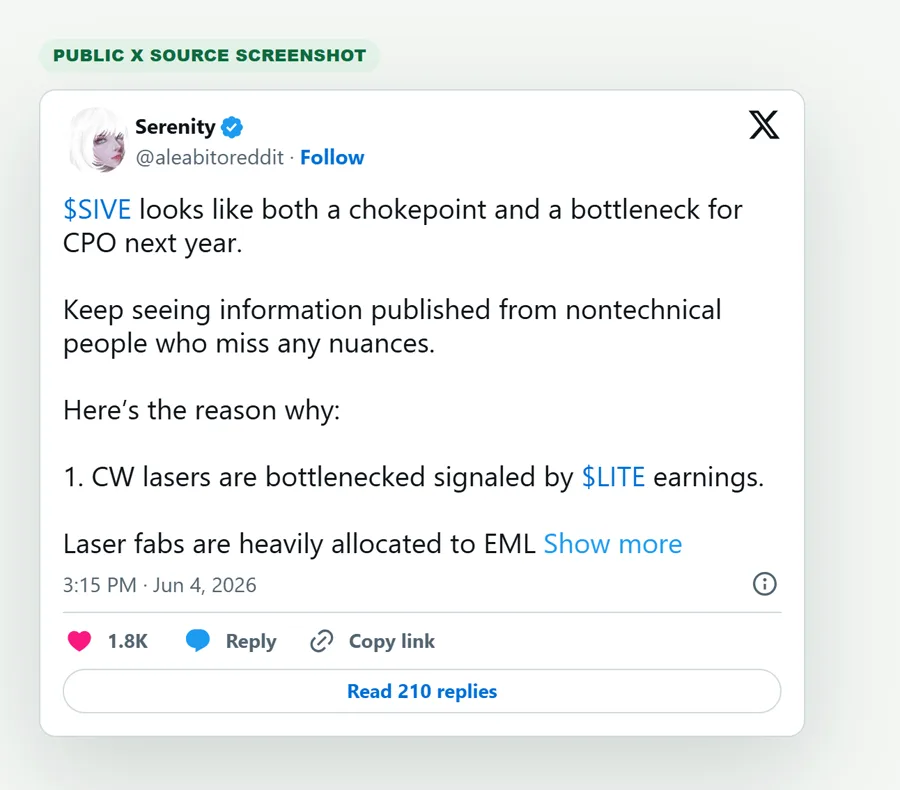 CPO thesis · 676K views
SIVE as a CPO bottleneck
The original post is the anchor because it ties CPO demand, suppliers, allocation, and several semiconductor tickers together.
SIVELITENVDAMRVLJBLGFSAMD
Open Serenity's SIVE CPO bottleneck post on X
CPO thesis · 676K views
SIVE as a CPO bottleneck
The original post is the anchor because it ties CPO demand, suppliers, allocation, and several semiconductor tickers together.
SIVELITENVDAMRVLJBLGFSAMD
Open Serenity's SIVE CPO bottleneck post on X
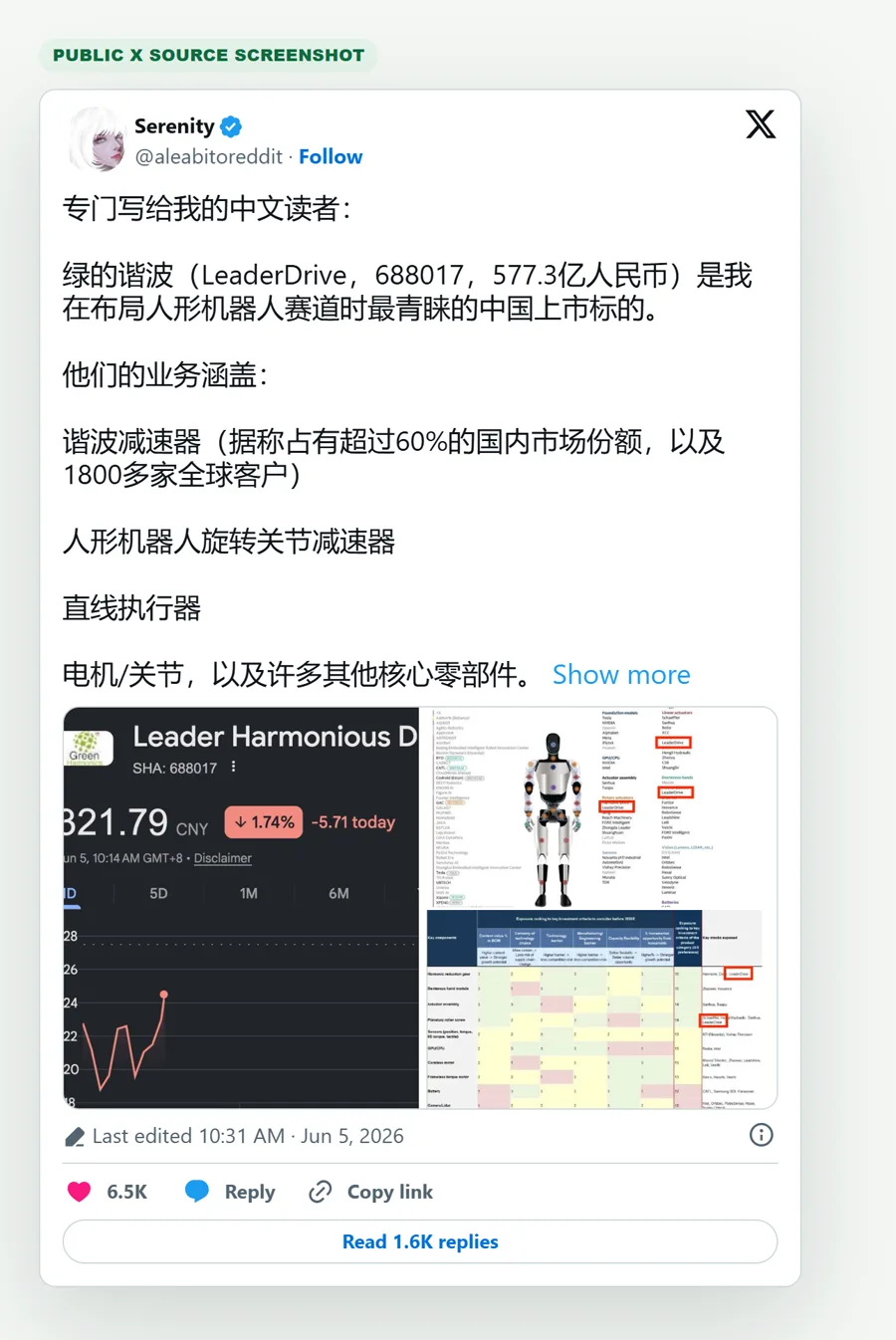 Robotics thesis · 3.26M views
LeaderDrive component map
This one is visually dense and partly bilingual, so a ticker list alone is not enough.
688017
Open Serenity's LeaderDrive robotics thesis on X
Robotics thesis · 3.26M views
LeaderDrive component map
This one is visually dense and partly bilingual, so a ticker list alone is not enough.
688017
Open Serenity's LeaderDrive robotics thesis on X
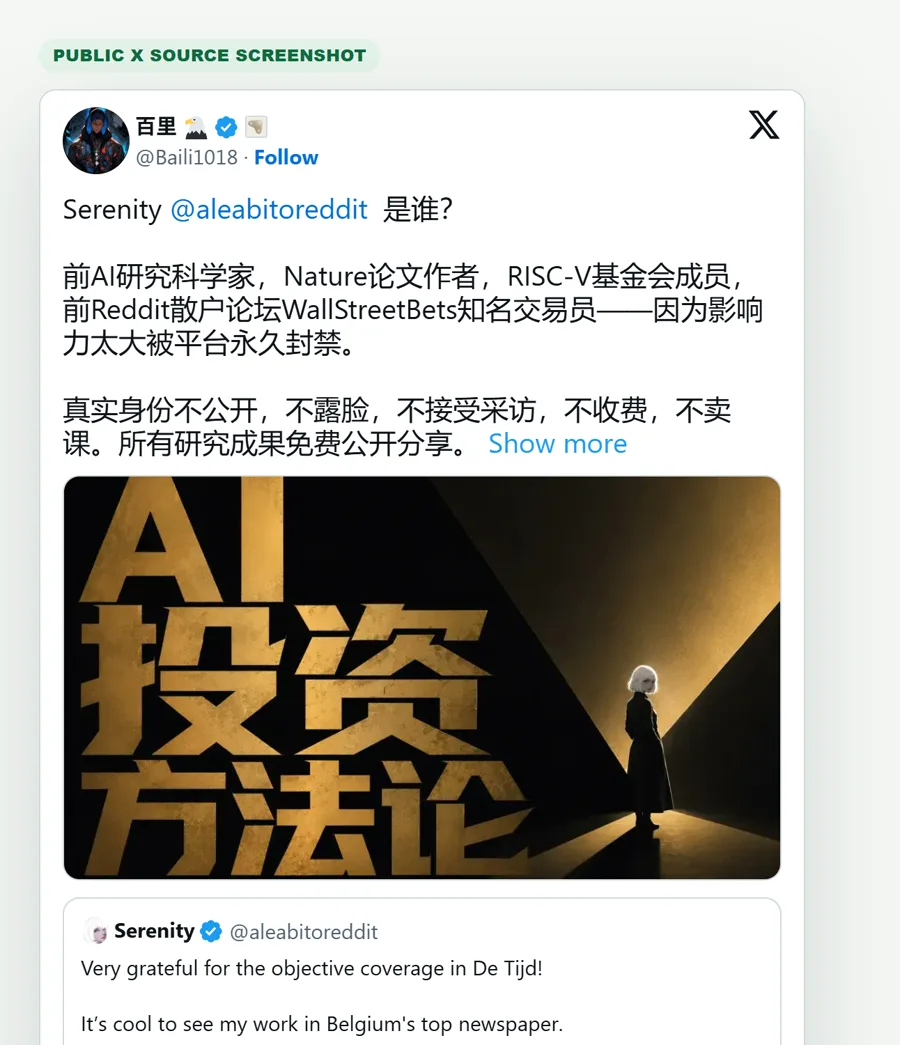 Discussion · 690K views
A community explainer about Serenity's method
This shows the second layer of demand: people are trying to understand the method, not only the tickers.
Open the Serenity method explainer on X
Discussion · 690K views
A community explainer about Serenity's method
This shows the second layer of demand: people are trying to understand the method, not only the tickers.
Open the Serenity method explainer on X
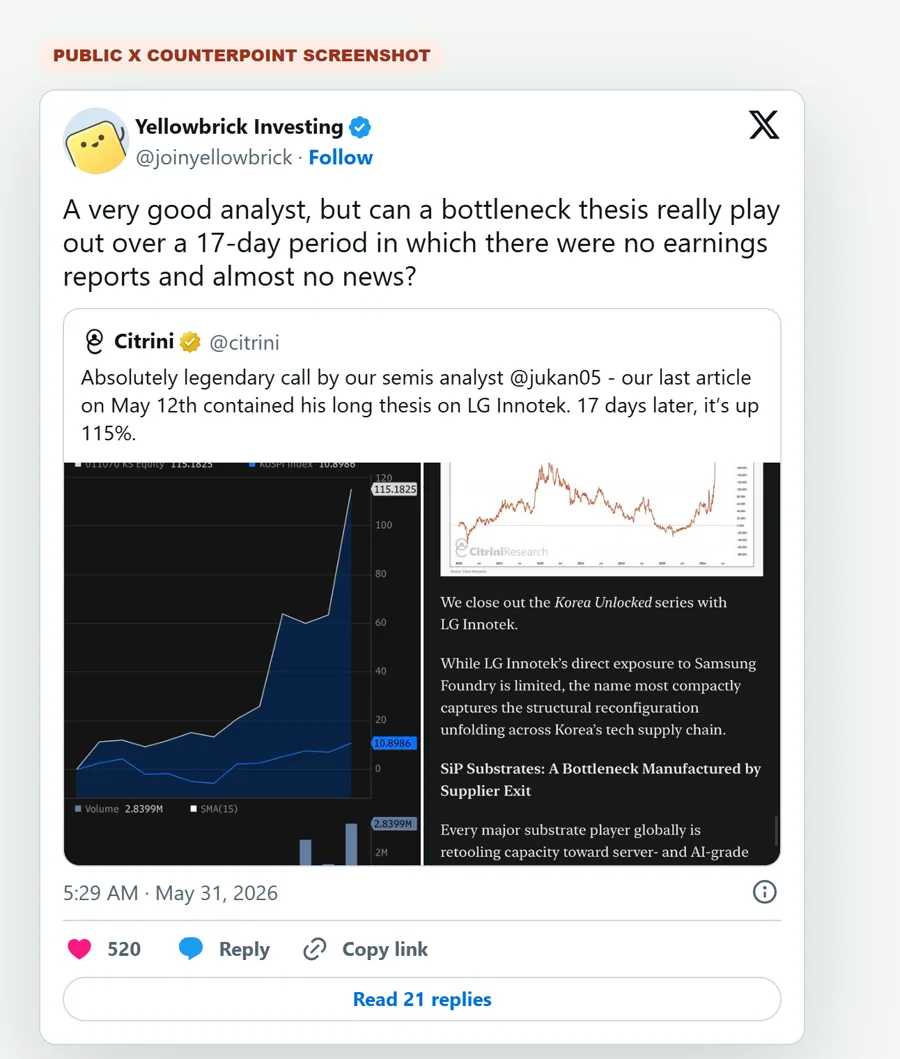 Counterpoint · 520 likes
A timing question that prevents fan-archive framing
Add this early so the research note does not read like a one-sided summary.
Open Yellowbrick's timing counterpoint on X
Counterpoint · 520 likes
A timing question that prevents fan-archive framing
Add this early so the research note does not read like a one-sided summary.
Open Yellowbrick's timing counterpoint on X
Why a Clean AI Summary Can Be Misleading
X stock research rarely arrives as one tidy argument. A long post may mix a thesis, a chart, a supplier map, a disclosure, a price move, and a few lines of excitement. A reply may contain the real clarification. A quote post may carry the best objection. A screenshot may be doing more work than the text.
That is where a normal AI summary can become too polished. The model may write a smooth paragraph that sounds useful while quietly dropping the date, the media, the original URL, or the fact that the strongest part of the idea was still an assumption.
For stock research, a polished answer is less useful than a map of where each point came from. If the note says there is a bottleneck, it should show whether that came from the post, from a reply, from an outside source, or from the model's own inference.
Build a Case File From One Post
Start with a narrow search, not a broad question. Queries such as from:aleabitoreddit SIVE or from:aleabitoreddit CPO are enough to find the first layer of the case without turning it into a ticker hunt.
The SIVE post is a good sample because it has the ingredients that make X stock research hard to preserve: a dense thesis, visible media, several tickers, follow-up discussion, and skeptical replies. That combination is exactly where a raw summary starts to lose important context.
After the counterpoints are added, the note should change shape. The original post supplies the CPO / laser / photonics bottleneck framing. Yellowbrick turns the timing into a question: can that story really be proven in a short window without fresh company evidence? Ningi Research turns the fundamentals into a question: does the SIVE framing fit the business evidence, or does it fit the narrative better than the company? The disagreement is not simply whether the post is right or wrong. It is about timing, company-specific exposure, and whether the public evidence is strong enough to support the bottleneck story.
That is the point where AI becomes useful. Not because it knows the trade, but because it can keep those three lanes apart: what the original post says, what the public debate adds, and what still needs to be checked somewhere more durable than X.
| Note | Record in the note | Check elsewhere |
|---|---|---|
| Original link | Serenity's SIVE CPO bottleneck post with about 676K views observed in the June 6, 2026 screenshot. | Do not treat views, likes, or price movement as proof. |
| Tickers named | SIVE, LITE, NVDA, MRVL, JBL, GFS, and AMD. Do not add extra names yet. | Expand only after the named set is clean. |
| Core claim | The post frames CPO lasers, photonics, and supplier allocation as a possible upstream bottleneck rather than a simple single-ticker mention. | CPO exposure, laser/photonics revenue, named customers, capacity comments, backlog/bookings, and recent guidance. |
| Unproven part | The bottleneck still has to be material, durable, and company-specific. Otherwise it may be broad CPO excitement with a ticker attached. | Look for earnings-call mentions, customer disclosures, supply agreements, segment revenue, or credible industry reporting. |
| Pushback | Pair it with Yellowbrick's timing objection and Ningi Research's skeptical SIVE thread. | Summarize timing and fundamentals objections before writing any bullish interpretation. |
The Prompt Should Protect the Reader
The first prompt should not ask whether SIVE, or any ticker from a viral post, is right or wrong. That pushes AI toward a verdict. The better prompt asks for boundaries: what came from the original post, what came from the surrounding discussion, and what still needs company evidence.
Readers who are not semiconductor specialists do not need ChatGPT to pretend every supply-chain term is settled. If you use ChatGPT to summarize Twitter stock posts, give it sources first, not a rumor. The useful output shows what part of the story is visible in the saved posts and what part is still a question.
I am studying a stock idea from public X/Twitter posts. Use only the links and text below.

For every important point, keep the original URL and date.

Return:
1. The main idea in plain language.
2. Tickers or companies explicitly mentioned.
3. What is visible in the saved posts, images, or links.
4. What is inferred but not proven yet.
5. Risks, objections, and missing checks.
6. Questions to verify in filings, earnings calls, customer disclosures, or credible news.
7. A tracker table with URLs in every row.

End with the decision points a human investor still has to judge.Put the Objection in Early
The easiest way to get a bad research summary is to feed the assistant only the exciting links. In the Serenity discussion, some posts try to explain the method, some package the account into skills or scanners, and some push back on timing or fundamentals. Those are different kinds of evidence, and they should not be blended together.
Search the discussion around the idea, not only the account that made it popular. Ask AI to summarize the objection before it writes any bullish interpretation. Use X's public and protected posts documentation as the rule: open posts can be studied; private, protected, deleted, login-only, or restricted content should not be treated as available evidence.
Where CarryFeed Actually Fits
A stock-research skill can be useful, but it is not a substitute for current public source material. The public yan-labs Serenity tweet archive and skill is useful because it packages historical material. It still cannot know which new reply, counterpoint, or follow-up changed the shape of the discussion today.
That is the modest but important role for CarryFeed. It does not turn public X/Twitter posts into investment truth. It gives readers and AI tools source links they can inspect, with URL, date, author, text, media clues, visible metrics, and follow-ups close enough to cite.
The clean split is simple: CarryFeed agent tools help collect public links and visible post details; AI organizes the idea; filings, earnings calls, company disclosures, and credible reporting still have to do the verification.
The Habit Worth Keeping
The habit worth keeping is not complicated: before believing a viral stock post, save the original, save the follow-up, save one objection, and make AI show where every important point came from.
That is also the line that keeps this habit from becoming trade copying. CarryFeed helps gather public posts. The assistant helps read them. Filings, earnings calls, company materials, and credible reporting still have to carry the final proof.
- Search the profile and ticker together.
- Keep the original URL, date, author, media, metrics, and ticker clues.
- Add a follow-up and a counterpoint before asking for analysis.
- Ask AI to separate evidence from inference.
- Verify anything important outside X before making decisions.
Questions readers usually ask.
Is this article investment advice?
No. It is about organizing open X stock research into link-backed notes. It does not recommend buying, selling, copying trades, or relying on any person's posts for financial decisions.
Why use Serenity as the case study?
The posts are useful because they are long, ticker-heavy, high-engagement, and surrounded by explainers, skills, scanners, and counterpoints. That makes the SIVE/CPO discussion a strong stress test for source-first AI stock research.
Can ChatGPT summarize Twitter/X stock posts for research?
Yes, but only after you give it clean public source details. For stock research, ChatGPT should keep Twitter/X URLs, dates, tickers, media, counterpoints, and missing checks attached instead of turning a viral post into a confident conclusion.
Can CarryFeed read private or subscriber-only posts?
No. CarryFeed works with public X/Twitter sources only. Private, protected, deleted, suspended, restricted, and login-only content is outside scope.
How is this different from a Serenity skill?
A skill can encode a research style. CarryFeed helps collect current posts, preserve URLs, and give the assistant the bounded context that a skill should reason over.
What belongs outside X?
Company filings, earnings-call transcripts, customer announcements, regulatory filings, patent records, credible news, and primary company materials. X posts can suggest questions; they should not be the final proof.
Can I use this with other stock accounts?
Yes, if the posts are public. Swap in another handle and ticker, then keep the same order: original posts first, follow-ups next, counterpoints before conclusions, and outside verification before decisions.
What if a post is deleted, restricted, or later looks wrong?
Mark that state in the tracker instead of asking AI to fill the gap. Deleted or restricted sources are not proof, and later corrections should be added as new sources rather than hidden.